AI agents built on foundation models (FMs) often misapply healthcare and life sciences (HCLS) decision frameworks, even when they’ve seen the guidelines in training and in the system prompt. Ask an agent to classify a TP53 missense variant using ACMG/AMP criteria. It will cite the correct framework but misapply evidence categories, skip population frequency thresholds, or hallucinate computational predictor scores. The model knows facts but lacks the structured reasoning procedures that domain practitioners internalize over years of training. The gap produces silent failures across variant interpretation, claims adjudication, clinical trial design, and imaging analysis. Outputs look correct but apply wrong criteria, with regulatory and patient safety consequences.
In this post, we share a collection of 38 open source agent skills spanning 11 HCLS domains that help close this methodology gap. We walk through installation and show how to use them across agentic AI services. We share our evaluation results to demonstrate measurable improvement across drug discovery, healthcare operations, and medical imaging workflows. Agents equipped with these skills win 70–86 percent of head-to-head comparisons against the same agents without skills, varying agent harness setup. The strongest effect is on critical thinking (78–85 percent win rate, d = 0.65–1.03). We also show you how you can customize, extend, and create your own agent skills for your specific use case.
Solution overview
Agent skills in the HCLS Agent Skills collection are structured markdown documents (SKILL.md) that encode domain decision procedures into a format AI agents can consume at inference time through progressive disclosure. Following the Agent Skills open standard, each skill declares triggers, dependencies, and metadata in YAML frontmatter. The content that follows contains decision frameworks, parameter tables, code patterns, and validation criteria. The collection covers 38 skills across 11 HCLS domains including genomics, drug discovery, claims operations, and medical imaging. Refer to the full skill catalog for the complete list organized by domain. All are released under the MIT-0 license.
Skills in this repository are sorted as either reasoning or pipeline skills. Reasoning skills encode methodology and decision frameworks that guide how the agent thinks. For example, the genomic-variant-interpretation skill encodes the full ACMG/AMP classification framework such as evidence categories, population frequency thresholds, and computational predictor cutoffs. Pipeline skills encode tool-specific commands, validated parameters, and code templates that produce runnable artifacts. The variant-calling skill provides GATK4 HaplotypeCaller commands with correct annotation groups, VQSR tranche sensitivity targets, and Mutect2 tumor-normal configurations.
This dual taxonomy gives agents both the judgment to make correct decisions and the technical precision to execute them. Unlike Retrieval Augmented Generation (RAG), which retrieves limited passages from indexed documents to augment the response generation, skills encode the decision procedure and error conditions itself. Skills are not fine-tuning either. They’re structured prompts that activate contextually based on trigger patterns in the user’s query.
Three properties make skills distinct from other approaches to domain specialization. Skills are auditable, portable, and straightforward to maintain. Every decision criterion is human-readable in markdown format, not hidden in model weights. A skill works across over 20 services (Amazon Bedrock AgentCore, AWS Strands Agents SDK, Kiro, Amazon Quick Desktop, Claude Code, OpenAI Codex and more) without customization to each. Annual medical policy changes or new experiment criteria can be reflected quickly by editing a text file, not retraining a model.
Now that you understand what skills contain, let’s set them up.
Prerequisites
To follow along with the examples in this post, you need one of the supported services from AWS: Kiro or Kiro CLI for interactive skill use and multi-agent orchestration, the AWS Strands Agents SDK with Amazon Bedrock foundation model access, AgentCore harness, a capability of Amazon Bedrock AgentCore, with an existing agent implementation, or Quick Desktop for GUI-based skill management. You can also use a coding agent harness of your choice such as Claude Code or OpenAI Codex. You also need Python 3.10+ with uv, and Git for cloning the repository.
Start by cloning the repository:
git clone https://github.com/awslabs/hcls-agent-skills.git
cd hcls-agent-skills
To install skills only without the agent configuration, use the universal skills CLI:
npx skills add awslabs/hcls-agent-skillsFor Kiro, the install.sh script installs both skills and a pre-configured agent that equips them. The agent handles skill routing automatically, so you don’t need to invoke individual skills by name. Run ./install.sh --target kiro, then switch to the agent in Kiro CLI with /agent hcls. For multi-agent mode, run ./install.sh --target kiro --mode multiagent and use /agent hcls-multiagent.
For the AWS Strands Agents SDK, load skills directly in your Python code:
from strands import Agent
from strands.skills import AgentSkills

agent = Agent(
    model=model_id,
    skills=AgentSkills(skills="./skills/"),
)
For AgentCore, follow Skills to add agent skills to an AgentCore-hosted agent. AgentCore provides managed hosting, auto scaling, security boundaries, and observability capabilities.
For Amazon Quick Desktop, run ./install.sh --target quick-desktop to see the full instructions for adding skills in the graphical interface. Alternatively, follow the instructions in Skills in the Amazon Quick documentation.
Solution walkthrough
With skills installed, we demonstrate three deployment patterns: the simplest single-agent approach in Quick Desktop, multi-agent orchestration in Kiro CLI that addresses context engineering challenges, and production deployment with Strands SDK on Amazon Bedrock AgentCore. We then show three sample use cases that highlight the measurable difference skills make in real HCLS workflows.
Agent skills in action with Quick Desktop
With skills installed, Quick Desktop’s agent gains structured HCLS domain reasoning without additional configuration. When you ask a domain question, the agent automatically activates relevant skills based on trigger patterns in your query. For example, asking “What is the RAF impact of coding E11.9 instead of E11.42?” triggers the risk-adjustment skill and the agent responds with specific HCC mappings, hierarchy resolution, and quantified RAF deltas rather than a generic suggestion to “review documentation.” Skills are activated selectively. Only the relevant skill is triggered for the response, helping keep output focused and accurate. The following video shows a skill dynamically loaded for the question in Amazon Quick Desktop.
Amazon Quick Desktop chat with the risk-adjustment skill dynamically loaded to respond to a RAF coding question
Multi-agent architecture with Kiro
Loading all 38 skills into a single agent context consumes ~80K tokens. This is workable with large-context models, but it creates a context engineering challenge. The agent must select the right subset from 38 available skills on every query and irrelevant skill content competes for attention. An alternative is explicit skill invocation (for example, /risk-adjustment), but this requires you to know which skill to invoke before asking your question, which is exactly the expertise gap skills are meant to bridge.
Kiro CLI’s multi-agent architecture solves both problems. A lightweight coordinator agent (no skills loaded) routes queries to eight domain specialists, each loading only its relevant skills (approximately 15K tokens per specialist). The coordinator handles intent classification while the specialists handle domain reasoning. The specialization can be defined as described in the following table.
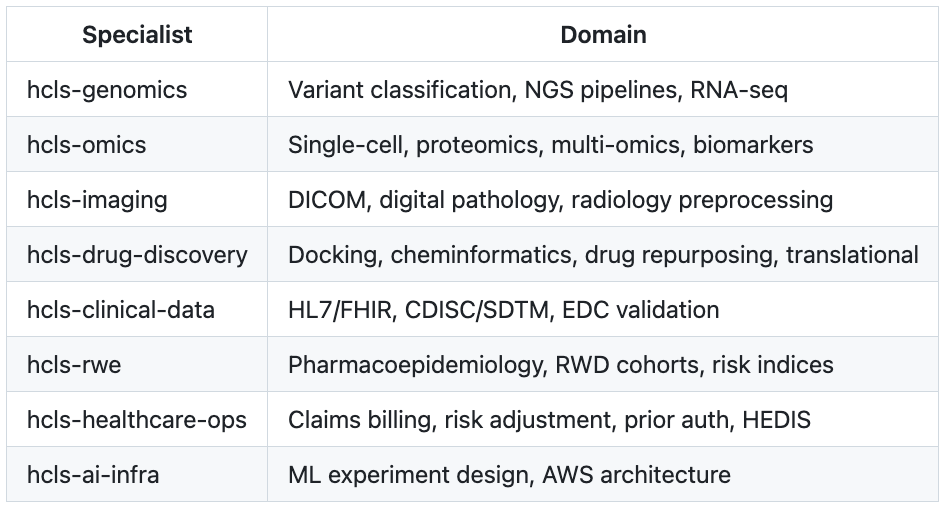
The multi-agent configuration is defined in JSON agent files. Refer to the coordinator agent config for the routing logic, and a specialist agent config for an example of how domain skills are attached to a specialist. The following video shows multiagent and dynamic skill activation answering a complex drug repurposing question while working in a code base in Kiro CLI.
Kiro CLI answering a drug repurposing question in a code base using multi-agent routing and dynamic skill activation
Strands SDK integration
The AWS Strands Agents SDK provides native skill loading for building custom HCLS agents:
from strands import Agent
from strands.skills import AgentSkills
from strands.multiagent import MultiAgentOrchestrator

# Define domain specialists with their skill sets
genomics_agent = Agent(
    name="hcls-genomics",
    model=model_id,
    skills=AgentSkills(skills="./skills/genomics/"),
)

imaging_agent = Agent(
    name="hcls-imaging",
    model=model_id,
    skills=AgentSkills(skills="./skills/imaging/"),
)

# Coordinator routes to specialists
coordinator = MultiAgentOrchestrator(
    agents=[genomics_agent, imaging_agent, ...],
    model=model_id,
)

response = coordinator("Classify NM_000546.6:c.743G>A in TP53 using ACMG criteria")
Deploying to Amazon Bedrock AgentCore
After your skill-equipped agent works locally, you can move it to production. Amazon Bedrock AgentCore provides an alternative path to inject skills into hosted agents. In addition to embedding them in the Strands agent code, you can configure skills at the environment level so they’re available to agents running in that harness. AgentCore harness provides managed hosting, auto scaling, security boundaries, and observability capabilities without managing infrastructure. Follow Skills in the AgentCore documentation.
With deployment covered, let’s look at what skill-equipped agents produce in practice. The following sample use cases are drawn from our evaluation prompt set.
Use case 1: Evaluating repurposing candidates for rare fibrotic disease in drug discovery
A team at a biotech company investigating drug repurposing for idiopathic pulmonary fibrosis (IPF) wants to evaluate approved drugs that modulate TGF-β1 signaling through the receptor kinase TGFBR1 (ALK5). In practice, a researcher needs to query drug-gene interaction databases, rank candidates by evidence strength, assess mechanism-of-action overlap with IPF pathophysiology, and determine translatability given existing safety data. However, a researcher might be quick to prompt an agent vaguely: “I’m investigating TGFBR1 as a therapeutic target for IPF. Are there any approved drugs worth repurposing? What’s the strongest candidate and how realistic is clinical translation?”
Before adding skills, the agent provides a general literature review listing known TGFBR1 inhibitors without structured ranking criteria, evidence hierarchy, or translatability assessment framework. After equipping the agent with skills, the agent triggers drug-repurposing, and translational-research skill and does the following:
- The agent applies the DGIdb query framework, prioritizing interaction types (inhibitor > modulator > binder) and source databases (ChEMBL, DrugBank) over lower-confidence sources.
- It ranks candidates using a structured evidence hierarchy where direct target engagement outweighs pathway-level evidence, which in turn outweighs phenotypic association, with existing indication relevance applied as a modifier.
- It assesses mechanism-of-action overlap by mapping TGFBR1 inhibition to the key IPF pathological processes: fibroblast-to-myofibroblast transition, epithelial-mesenchymal transition, and extracellular matrix deposition.
- It evaluates clinical translatability using T0→T1 criteria, examining existing safety data from the original indication, therapeutic window compatibility, and concordance between available preclinical fibrosis models and human disease.
The skill chain transforms a surface-level response into a structured regulatory-aware evaluation with quantified evidence rankings.
Use case 2: Building a CMS-HCC risk adjustment pipeline in healthcare claims operations
A Medicare Advantage plan with 12,000 members needs to calculate Risk Adjustment Factor (RAF) scores from ICD-10 diagnosis claims data using CMS-HCC Model V28 coefficients. The pipeline must apply the ICD-10-to-HCC crosswalk, resolve disease hierarchies correctly, and compute final member-level risk scores with demographic adjustments. However, a junior analyst may prompt the agent: “We’re a Medicare Advantage plan with 12,000 members. We have ICD-10 diagnosis claims in a PostgreSQL database (member_diagnoses and member_demographics tables). Build me a pipeline to calculate member-level RAF scores for the current payment year.”
Before adding skills, the agent produces a plausible but incomplete pipeline, often missing hierarchy resolution entirely, using outdated V24 coefficients, or applying hierarchies after summing (which inflates scores). After equipping the agent with skills, the agent triggers risk-adjustment, and claims-billing-rules skill and does the following:
- The agent generates correct SQL that joins diagnosis codes to the
ICD-10-to-HCCcrosswalk table with deduplication within the measurement year, making sure each HCC is counted only once per member. - It implements V28 hierarchy resolution correctly, where HCC 18 (Diabetes with Chronic Complications) supersedes HCC 19 (Diabetes without Complications) and HCC 326 (CKD Stage 5) supersedes HCC 327 (CKD Stage 4), helping prevent double-counting at multiple specificity levels.
- It applies the correct demographic segmentation by categorizing members into community, institutional, or dual-eligible populations with age/sex adjustments before summing HCC coefficients.
- It proactively explains that skipping hierarchy resolution double-counts conditions at multiple specificity levels, systematically inflating RAF scores and creating audit liability under CMS RADV review.
The skill supports producing audit-defensible RAF scores rather than inflated estimates that would trigger CMS RADV audit findings.
Use case 3: T1-weighted MRI preprocessing for voxel-based morphometry in medical imaging research
A neuroimaging study with 45 healthy adults needs a standard T1w preprocessing pipeline for voxel-based morphometry (VBM) analysis. Raw DICOM data has been converted to NIfTI. The pipeline must reorient, correct bias field, skull-strip, and register to MNI152 space in the correct order and with para