Insurance claims adjusters spend over 100 minutes per case manually reviewing medical records. The EXL AI-powered Medical intelligent document processing (IDP) solution, built on AWS, transforms this process. It combines IDP with domain-specific large language models (LLMs) to extract, summarize, and query medical information at enterprise scale.
Challenge: Medical records are complex, voluminous, and critical
In insurance claims adjudication and life underwriting, medical records are the foundation of every decision. Claim adjusters and underwriters must review these records, often several hundred pages long, to assess validity, determine payouts, or make underwriting decisions.
The challenge isn’t simply volume. Medical records are unstructured, filled with specialized clinical terminology, and require the reviewer to connect disparate data points about a patient’s condition and its evolution over time. The documents themselves span dozens of types: chiropractic care notes, diagnostic tests, emergency room visits, operative reports, physician consultations, prescription drug reports, psychiatric evaluations, lab results, independent medical examination (IME) reports, and peer reviews, among others.
This review demands deep medical domain expertise, sustained concentration, and interpretive judgment. Given this complexity, the process is slow, manual, and prone to inconsistencies. Different professionals interpret the same medical data in different ways. The consequences are real: delayed claim settlements, accuracy issues in evaluations, increased indemnity costs, adverse customer experience, and heightened regulatory scrutiny.
About EXL
EXL is a data analytics, AI, and digital solutions provider serving Fortune 500 organizations for over 25 years. With over 50,000 professionals globally, EXL brings deep expertise in insurance, healthcare, banking, capital markets, retail, media and communications, and energy to reimagine business models, deliver measurable outcomes, and accelerate innovation.
Solution: Two AI applications, one intelligent pipeline
EXL addressed this challenge by combining two complementary AI applications into a single end-to-end solution, hosted on AWS:
- Xtrakto.AI handles document ingestion, splitting, classification, extraction, enrichment, and postprocessing. It is a template-agnostic IDP application that uses computer vision, natural language processing (NLP), and agentic AI workflows to extract structured data from various document types without requiring pre-configured templates.
- EXL Insurance LLM provides the domain intelligence layer: medical summarization, natural-language querying, deep reasoning with traceability, and structured output generation. Fine-tuned on insurance and medical domain data, it understands clinical terminology, ICD (International Classification of Diseases) and CPT (Current Procedural Terminology) codes, diagnosis-treatment relationships, and the specific needs of claims and underwriting workflows.
Together, these applications form an automated, scalable pipeline that transforms raw medical documents into actionable intelligence for claims adjusters, underwriters, and care coordinators.
EXL built the solution on AWS to keep model development and production inference under one roof with consistent security controls. Amazon SageMaker AI provides the managed training and inference environment for the domain-specific EXL Insurance LLM: multi-GPU fine-tuning, isolated experimentation separated from production, and real-time inference endpoints that scale with claim volume. Amazon Bedrock complements this with on-demand access to general-purpose foundation models through a single API. With this access, EXL can apply the right model to each task: the fine-tuned Insurance LLM for domain reasoning and general-purpose models for broader language tasks, without managing additional infrastructure. Both services operate within access controls scoped by AWS Identity and Access Management (IAM), which is essential for a workflow handling protected health information.
Architecture overview
The solution runs entirely within an AWS Region, with upstream and downstream client applications connecting through secure APIs. The architecture follows an 11-step flow, from ingestion through output delivery, with a separate model development environment for continuous improvement.
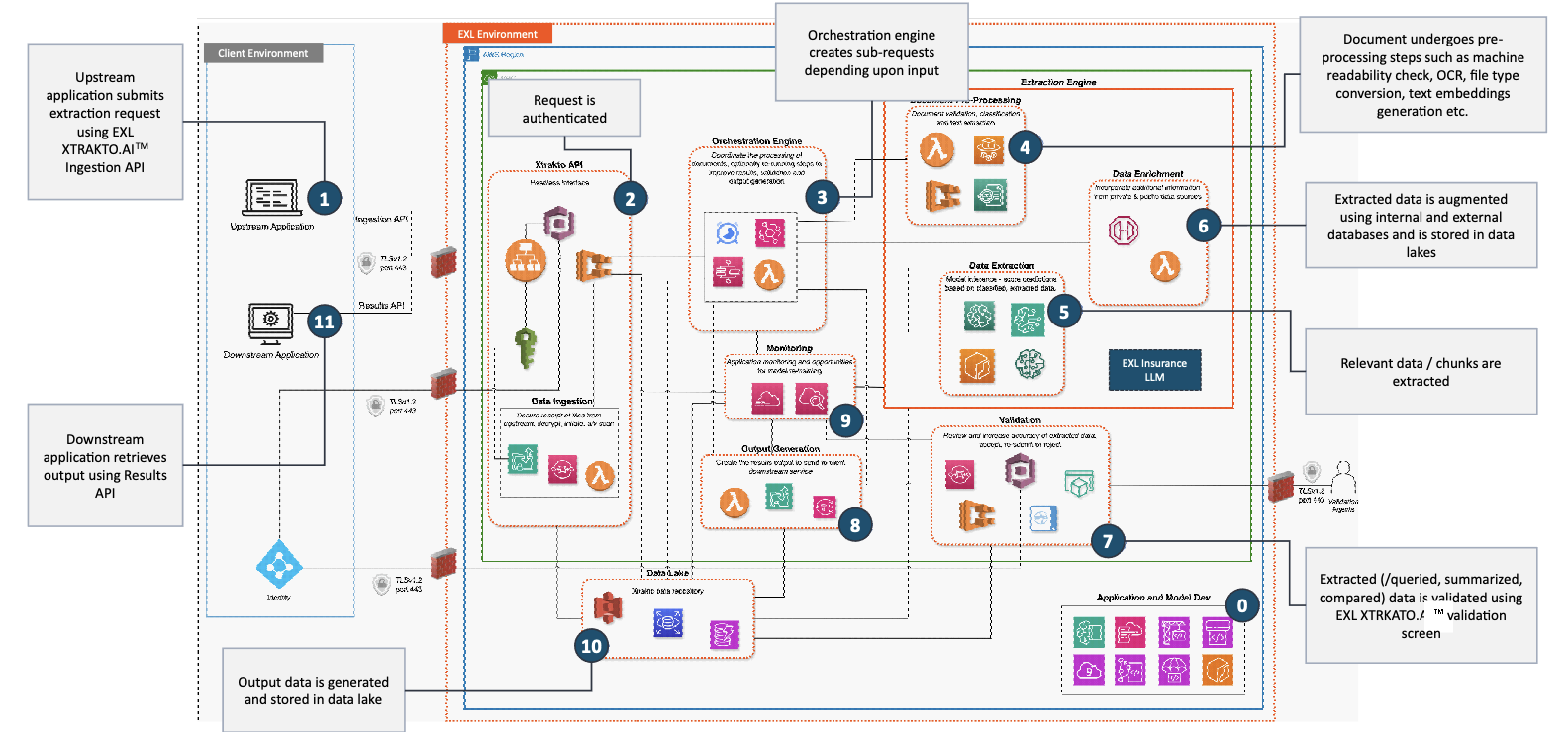
The pipeline is built on the following AWS services:
- Amazon API Gateway for secure ingestion and results delivery APIs (steps 1 and 11).
- Amazon Cognito for request authentication and authorization (step 2).
- AWS Step Functions as the orchestration engine that coordinates sub-requests, routing, and extraction workflows (step 3).
- Amazon Textract and AWS Lambda for document preprocessing: machine readability checks, OCR, file type conversion, and text embedding generation (step 4).
- Amazon SageMaker AI for machine learning (ML) model inference and data retrieval based on trained domain models (step 5).
- Amazon DynamoDB and Amazon Relational Database Service (Amazon RDS) for data enrichment using internal and external reference databases (step 6).
- Amazon SageMaker AI real-time inference endpoints serve the EXL Insurance LLM for validation, summarization, querying, and agentic reasoning (step 7).
- Amazon Bedrock provides on-demand access to general-purpose foundation models that complement the domain-specific EXL Insurance LLM for general reasoning tasks. For model availability by AWS Region, refer to Supported models by AWS Region in Amazon Bedrock.
- AWS Lambda for output generation in multiple formats (step 8).
- Amazon CloudWatch for application and model monitoring dashboards (step 9).
- Amazon Simple Storage Service (Amazon S3) as the central data lake for document storage and processed outputs (step 10).
- Amazon SageMaker AI (in an isolated model development environment) for model training, fine-tuning, and experimentation (step 0).
Building the EXL Insurance LLM on Amazon SageMaker AI
A critical differentiator of this solution is the EXL Insurance LLM: a domain-specific large language model fine-tuned specifically for insurance claims workflows involving medical records. Rather than relying on general-purpose LLMs that lack specialized insurance and medical domain knowledge, EXL built a purpose-trained model on Amazon SageMaker AI, benchmarked against general-purpose models on insurance-specific NLP tasks.
Why fine-tune rather than prompt?
General-purpose models like GPT-4 or Claude possess broad language understanding but lack the specialized vocabulary, reasoning patterns, and workflow awareness needed for insurance claims adjudication. Insurance claims involve multiple distinct tag types for medical record annotation, domain-specific summarization formats (economic and non-economic damages), and negotiation guidance generation. These tasks require deep domain adaptation that prompting alone cannot achieve consistently at scale.
Training data and preparation
EXL curated training data from nine years of insurance claims operations, comprising over 13,500 records spanning both structured database records and unstructured medical documents. The data preparation pipeline on AWS included:
- Optical character recognition (OCR) with Amazon Textract: Extracting text from scanned medical PDFs while preserving positional context at the line and word level, critical for maintaining the relationships between medical findings.
- Junk page detection: An automated classifier to identify and remove irrelevant or poorly scanned pages that would degrade training quality.
- Data de-identification: De-identification procedures that align with HIPAA requirements to remove protected health information before training, so the model does not learn sensitive patient data.
- Multi-tag consolidation: Grouping multiple tag citations per page into unified training examples, helping prevent the model from producing inconsistent outputs when a single page contains multiple medical findings.
Fine-tuning approach on SageMaker AI
EXL used Parameter-Efficient Fine-Tuning (PEFT) with Low-Rank Adaptation (LoRA) on Amazon SageMaker AI. This approach adapts the model efficiently without modifying all parameters of the base model, reducing compute costs while maintaining performance. The training used:
- Multi-GPU configurations on SageMaker AI training instances with NVIDIA GPUs.
- Advanced parallelism (data and model parallelism) to optimize training throughput at scale.
- NVIDIA NeMo framework for building and managing the training pipeline.
- Isolated SageMaker AI environment (step 0 in the architecture) separated from production inference, so model experimentation does not impact live workloads.
Performance results
In internal benchmarking by EXL, the fine-tuned EXL Insurance LLM showed strong performance across key claim-workflow tasks (tagging, summarization, question-answering, and reasoning), assessed using automated metrics (BLEU, ROUGE, BERTScore, METEOR) and blind review by three insurance subject-matter experts.
For methodology and detailed results, see EXL white paper on the Insurance LLM.
With this pipeline, EXL reduced medical record review time from days to hours, with human-in-the-loop validation at critical stages helping maintain quality while reducing turnaround time.
How it works: From document to decision
The pipeline moves each document through seven stages, from ingestion to structured output delivery. The following sections walk through each stage.
Stage 1: Document splitting and classification
The pipeline begins when upstream applications submit extraction requests through the Ingestion API, built on Amazon API Gateway. Documents arrive through multiple channels and in multiple formats. AWS Lambda functions handle initial file processing using Apache Tika for parsing and post-OCR normalization, storing raw documents in Amazon S3.
After authentication through Amazon Cognito, the orchestration engine (AWS Step Functions) takes over, creating sub-requests based on the input and routing content to appropriate processing modules.
Xtrakto.AI’s classification engine is template agnostic and inference based. Rather than relying on document layout or predefined templates, it uses few-shot and transfer learning methods to classify content based on meaning and context. As a result, the system can classify new document types with limited training samples. Bundled files (email messages with multiple attachments) are split into individual sub-documents, each routed to the appropriate downstream extraction module.
Stage 2: Data extraction with confidence scoring and traceability
This is the core of the pipeline, where Xtrakto.AI’s extraction capabilities come together across preprocessing, computer vision, and domain-specific extraction.
Preprocessing
Documents undergo machine readability checks, OCR with Amazon Textract, file type conversion, and text embedding generation. These steps run as Lambda functions coordinated by Step Functions. Computer vision models (CNNs, RCNNs) deployed on Amazon SageMaker AI process the pixel-level image data to address quality issues common in scanned medical records: low resolution, noise from wrinkles or stains, skewness, and mixed handwritten and printed content. These models identify duplicate pages, detect bounded and unbounded tables, identify extraction zones, detect signatures, and interpret barcodes and QR codes.
Approximately 25–30 percent of documents contain handwritten content, ranging from structured form fills (low complexity, approximately 50–60 percent of handwritten volume) to semi-structured annotations (approximately 15–20 percent) to fully free-form physician notes (approximately 15–20 percent). Each type requires specialized processing.
Context-based extraction
Xtrakto.AI doesn’t configure input templates to look for information at specific locations. Extraction is context based:
- For structured and semi-structured documents, computer vision (CV) models identify zones and extract key-value pairs. A built-in domain ontology combined with semantic similarity NLP models maps extracted keys to business-specific fields.
- For highly unstructured content (physician notes, operative reports), extraction is orchestrated through a LangGraph-based agentic workflow. This decomposes extraction into structured reasoning steps, using machine comprehension and question-answering models for targeted field-level extraction, while transformer models provide contextual understanding for ambiguous cases.
Amazon SageMaker AI hosts the family of inference models used for extraction. Traditional approaches (SVM, gradient boosting) handle structured classification tasks, and transformer architectures (BERT, GPT, BART variants) enriched with domain-specific medical and insurance data handle contextual extraction.
Confidence scoring and human-in-the-loop
Every extracted field receives a confidence score of 0-100. Fields below a configurable threshold are routed to human validators through the EXL Xtrakto.AI validation screen for verification. This feedback continuously improves model accuracy over time.
Stage 3: Data enrichment and integration
Extracted data is augmented using internal and external reference databases stored in Amazon DynamoDB and Amazon RDS. This enrichment step validates extracted codes against ICD-10, CPT, and Healthcare Common Procedure Coding System (HCPCS) libraries, normalizes dates and terminology, and resolves cross-field consistency issues. Enriched data is stored back in the Amazon S3 data lake for downstream consumption.
Stage 4: Intelligent summarization
This is where the EXL Insurance LLM takes over, served from inference endpoints on Amazon SageMaker AI. Complex medical records spanning hundreds of pages are condensed into structured summaries tailored to the user’s needs.
The summarization engine offers flexibility: users choose between short, medium, or long summaries depending on their workflow. The Insurance LLM extracts, labels, summarizes, and presents the most relevant clinical information while preserving the original context and narrative flow of the document.
Through a feedback mechanism, users can rate and correct summaries. These corrections feed into model fine-tuning on Amazon SageMaker AI, continuously improving summarization quality.
Stage 5: Natural-language querying
Beyond summaries, users need to ask specific questions about a medical record and get precise, sourced answers. The querying capability, powered by the Insurance LLM on Amazon SageMaker AI, supports three modes:
- Pre-defined FAQs for common questions across claim types.
- Bundled questions that group related queries and fire them together for batch processing.
- Open queries in everyday language, letting users retrieve specific information without complex search syntax.
The Insurance LLM understands the intent behind each query and provides accurate answers grounded in the underlying document data. It handles multiple queries simultaneously, making it practical for high-volume operational use.
Stage 6: Deep reasoning with traceability
For complex cases requiring clinical judgment support, the solution provides deep reasoning capabilities with full traceability:
- Source-level traceability: Every Q&A response and summary links back to the exact source data or document segment, so reviewers can verify AI-generated insights against original records.
- Overwrite and feedback: Users can correct inaccuracies by editing generated summaries or answers and rate the quality of outputs. These corrections feed into continuous model improvement, creating a virtuous cycle where the system becomes more accurate with use.
This traceability is essential in regulated environments where decisions must be auditable and defensible.
Responsible AI and production safeguards
Because this workflow handles protected health information and produces AI-generated clinical and claims insights, responsible-AI controls are built into the deployment rather than added on. Generative outputs pass through content-filtering and grounding checks before they reach a reviewer, so summaries and answers stay anchored to th